- Every OBD2 code has five characters: a system letter (P, B, C, U) followed by four digits that narrow down the fault.
- A basic OBD2 scanner reads and clears codes, shows freeze-frame data and checks emissions readiness.
- Misfire (P0300–P0308), lean (P0171 / P0174), catalyst (P0420) and EVAP (P0442 / P0455) codes are among the most common.
- Clearing a code turns the light off but does not fix the cause — always diagnose before clearing.
The check-engine light is the most common reason drivers buy an OBD2 scanner. Behind every light is a diagnostic trouble code (DTC) stored by the engine computer. Knowing how to read those codes — and what the most common ones mean — saves money at the shop and helps parts sellers recommend the right products. This guide explains the code structure, how to read codes step by step, and the codes drivers see most often.
How OBD2 codes are structured
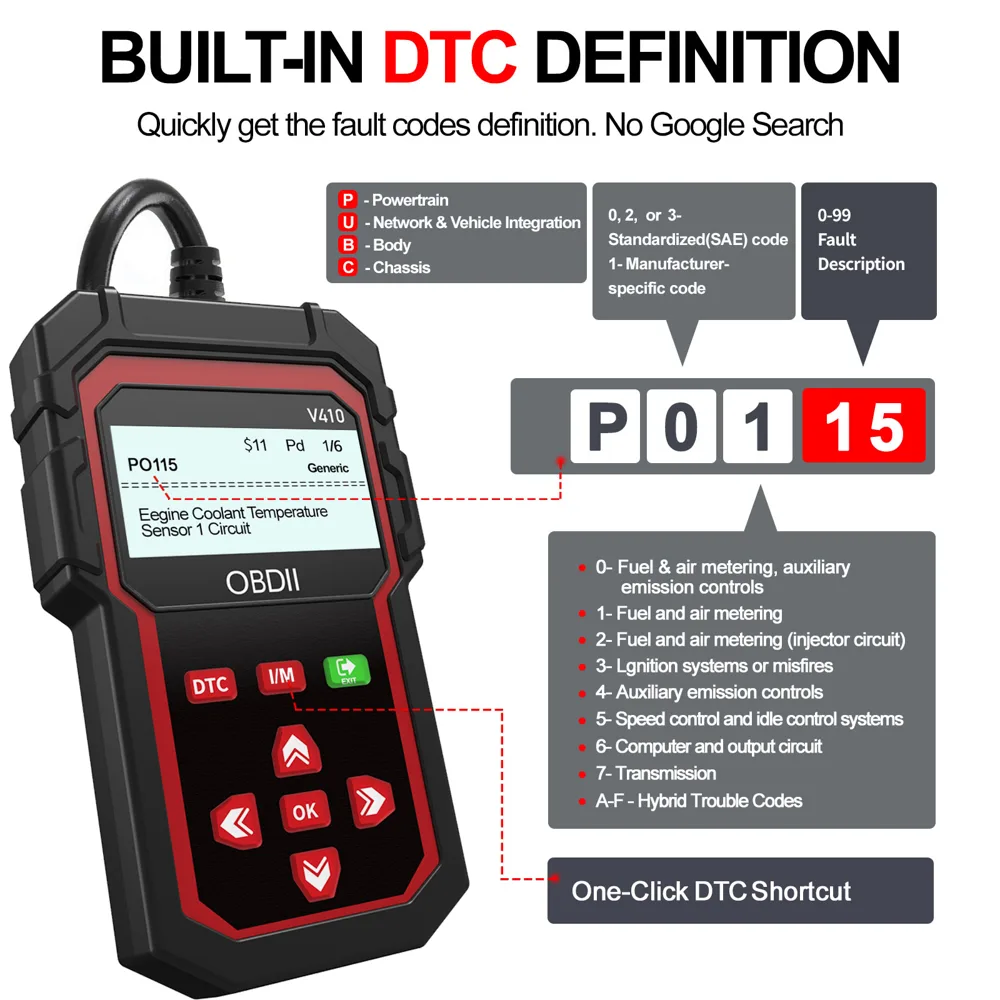
Every standard OBD2 code has five characters, for example P0301:
| Position | Example | Meaning |
|---|---|---|
| 1st — system | P | P = Powertrain, B = Body, C = Chassis, U = Network / communication |
| 2nd — code type | 0 | 0 = generic (SAE standard), 1 = manufacturer-specific |
| 3rd — subsystem | 3 | For P-codes: 1–2 fuel & air metering, 3 ignition / misfire, 4 emission controls, 5 speed & idle control, 6 computer & outputs, 7–9 transmission |
| 4th–5th — fault | 01 | The specific fault — here, cylinder 1 |
So P0301 reads as: powertrain, generic code, ignition system, misfire on cylinder 1.
How to read OBD2 codes step by step
- Find the OBD-II port under the dashboard on the driver's side.
- Plug in the scanner with the ignition off. A handheld reader powers on from the port; a Bluetooth or WiFi adapter needs a phone app.
- Turn the ignition on (engine running or key-on, engine-off, as the tool instructs).
- Select "Read Codes" and note every code, including pending codes.
- Check freeze-frame data — the engine conditions (speed, temperature, load) when the fault was recorded.
- Diagnose and repair the cause, then clear the codes and confirm the light stays off.
The most common check-engine codes
| Code | Meaning | Common causes |
|---|---|---|
| P0300 | Random / multiple cylinder misfire | Spark plugs, ignition coils, vacuum leaks, fuel delivery, valve-train problems |
| P0301–P0308 | Misfire on a specific cylinder (1–8) | Plug or coil on that cylinder, injector, or a lifter / valve not opening |
| P0171 / P0174 | System too lean (bank 1 / bank 2) | Vacuum leaks, dirty mass-airflow sensor, weak fuel pump or clogged filter |
| P0420 | Catalyst efficiency below threshold (bank 1) | Aging catalytic converter, O2 sensor issues, exhaust leaks |
| P0442 | EVAP system small leak | Loose or worn fuel cap, cracked EVAP hose, purge valve |
| P0455 | EVAP system large leak | Missing or loose fuel cap, disconnected EVAP line |
| P0128 | Coolant temperature below thermostat regulating temperature | Thermostat stuck open, coolant temperature sensor |
| P0101 | Mass airflow (MAF) sensor range / performance | Dirty MAF sensor, air leaks after the sensor, intake restrictions |
| P0011 | Intake camshaft timing over-advanced (bank 1) | Low or dirty oil, cam phaser or oil control valve |
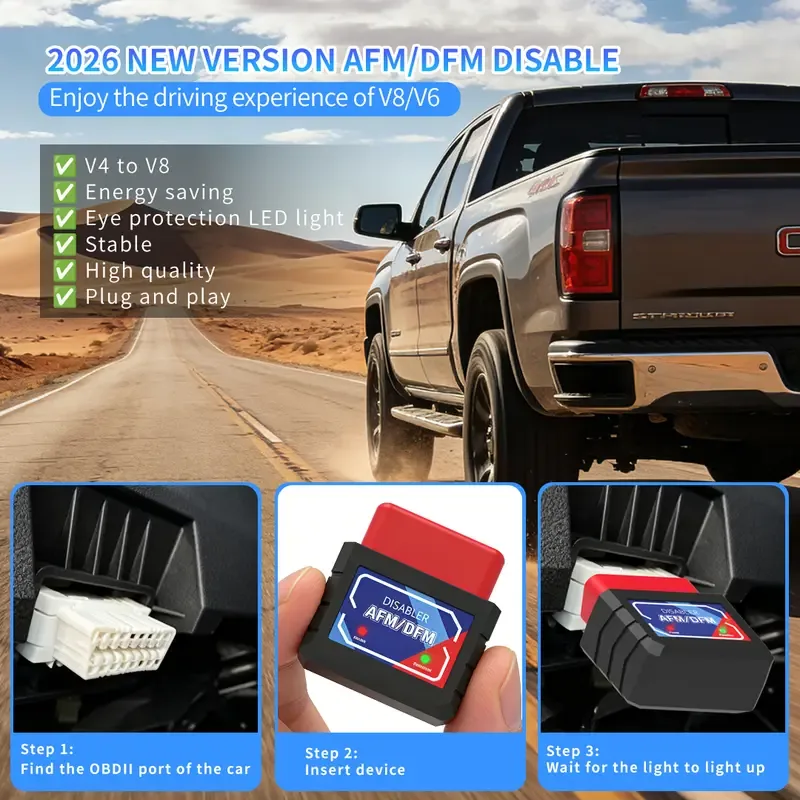
Codes GM AFM / DFM owners should know
On GM engines with cylinder deactivation, a few codes are worth special attention:
- P3400 — Cylinder deactivation system (bank 1): a GM-specific code related to the AFM / DFM system, often linked to oil pressure, the lifter oil manifold solenoids or wiring.
- P0300–P0308 misfires: on AFM engines, a misfire on a cylinder that deactivates can point to a collapsed or sticking lifter — especially when combined with a ticking noise.
- Oil pressure-related codes: because AFM lifters depend on oil pressure, oil level and quality matter.
If an AFM engine shows misfire codes together with a ticking noise, have it inspected before installing a disabler. For background, see AFM lifter failure causes and symptoms.
Pending, stored and permanent codes
- Pending codes — the computer has seen a possible fault once; the light may not be on yet.
- Stored (confirmed) codes — the fault was confirmed and the check-engine light is on.
- Permanent codes — cannot be cleared with a scanner; they clear themselves after the repair is confirmed by the vehicle's own self-tests.
Should you clear a code?
Clearing codes turns off the check-engine light and resets readiness monitors, but it does not fix anything. If the fault is still there, the light will come back. Clearing codes right before an emissions inspection is also a common mistake: the readiness monitors need time and a drive cycle to complete, and many inspections will not pass a vehicle whose monitors are not ready. Diagnose first, repair, then clear.
Which OBD2 scanner is right for reading codes?
| Type | Best for | Example models |
|---|---|---|
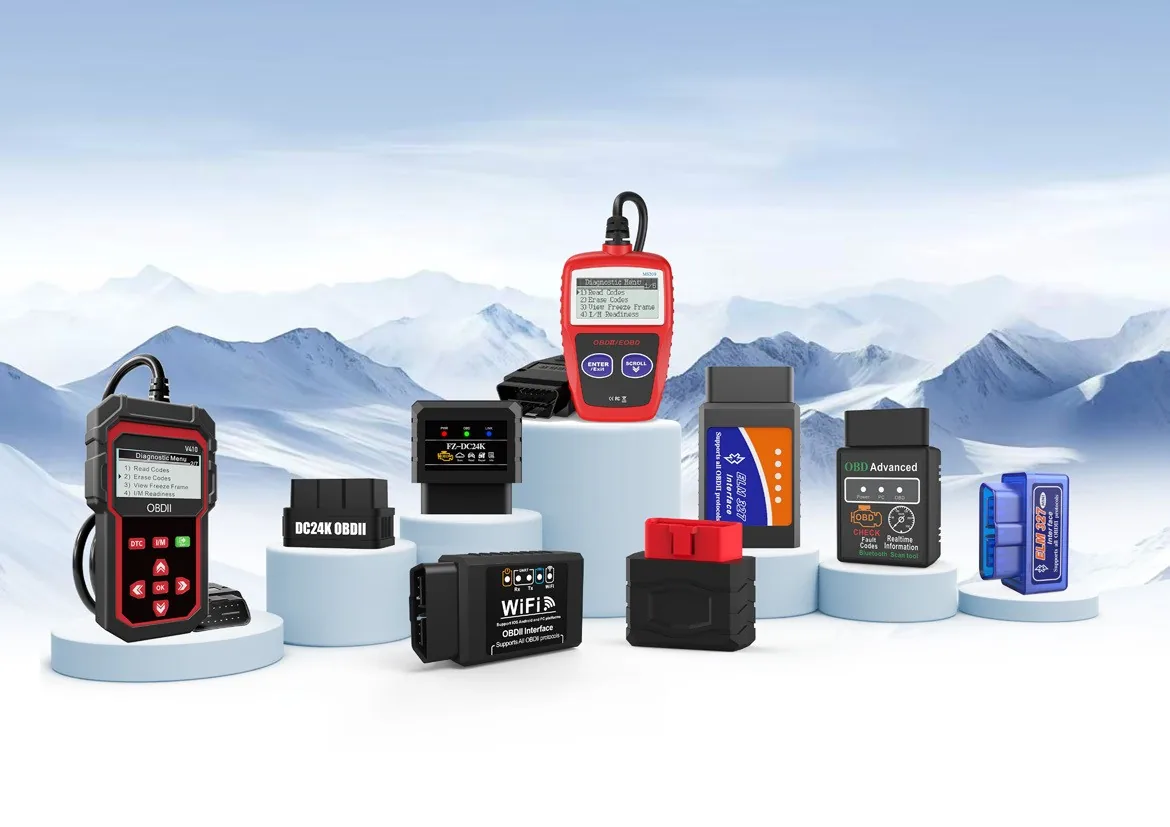
| Handheld code reader | Quick checks without a phone; workshops; older drivers | V410 (KS-8807), MS309 (KS-8808) |
| Bluetooth adapter + app | Live data, graphs and trip logging on Android (and iOS with BLE models) | DC24K Bluetooth 5.4 (KS-8809), Mini ELM327 (KS-8801) |
| WiFi adapter + app | iPhone users who want an app-based scanner | Mini WiFi (KS-8804), DC24K WiFi 6 (KS-8810) |
For a deeper comparison of adapters, chips and voltage ranges, read our OBD2 scanner buying guide.
Tips for parts sellers
- Pair scanners with common repair parts — spark plugs, coils, fuel caps and sensors match the most common codes.
- Create content around specific codes — "what does P0420 mean" style videos and posts attract buyers who are ready to purchase.
- Offer a handheld and an app-based option to cover both non-technical and tech-savvy customers.
All our OBD2 scanners are available factory-direct, in neutral packaging or with your own brand from 1,000 pcs. Browse the catalog or request a quote.
Frequently asked questions
Can I drive with the check-engine light on?
If the light is steady, the car is usually safe to drive to a shop soon, but have the code read promptly. If the light is flashing, it often signals an active misfire that can damage the catalytic converter — reduce speed and get it checked as soon as possible.
Will disconnecting the battery clear OBD2 codes?
It may clear stored codes on many vehicles, but it also resets other settings and readiness monitors. Using a scanner is cleaner, and the fault itself still needs to be fixed.
What is the difference between P0 and P1 codes?
P0 codes are generic SAE codes that mean the same thing on every vehicle. P1 codes are manufacturer-specific, so their meaning depends on the brand.
Do cheap OBD2 scanners read all codes?
Basic scanners read generic powertrain codes on OBD2-compliant vehicles. Manufacturer-specific codes and body, chassis or network modules may need more advanced tools or apps.
Factory-direct pricing, samples and private label from 1,000 pcs.